What Does Your Team Know About Grain Bin Safety?
Grain Bin Safety Week is a powerful reminder that the most important piece of safety equipment on any site is an informed, well-trained team. Grain bin incidents are rarely the result of a single mistake; more often, they stem from gaps in understanding, missing or outdated procedures, or complacency around familiar tasks.
When it comes to grain bin entry, “we’ve always done it this way” is not a safety plan. Educating your workforce—operators, supervisors, maintenance, and management alike—must be the foundation of your grain handling safety program.
Below are key areas where training, clear policies, and practical tools work together to prevent serious incidents.
- Making sure everyone understands grain bin hazards
- Building and maintain clear, practical policies & procedures
- Training for real-world conditions, not just compliance
- Using monitoring tools to support – not replace – good practices
1. Make Sure Everyone Truly Understands Grain Bin Hazards
People who work around grain every day can easily underestimate its risks. Training should go beyond the basics to ensure your team understands how and why injuries happen.
Critical grain bin hazards to cover in employee education:
Engulfment and Entrapment
- Bridged grain can collapse under a worker’s weight.
- Vertical grain walls can cave in without warning.
- Flowing grain acts like quicksand; a person can be trapped within seconds and fully engulfed in less than a minute.
- Even partial entrapment is extremely difficult to self-rescue from; coworkers often become secondary victims when they attempt unplanned rescues.
Atmospheric Hazards
- Dust, mold, and biological contaminants can irritate airways or cause long-term lung damage.
- Off-gassing from spoiled or treated grain can displace oxygen or create toxic atmospheres.
- Oxygen-deficient or contaminated air may not be obvious without monitoring; workers can feel “a little off” right before they collapse.
Dust Explosion Risks
- Fine combustible grain dust, when suspended in air and confined, can explode if there is an ignition source.
- Housekeeping alone is not enough—layers of settled dust can become airborne during normal operations or maintenance.
- Secondary explosions, triggered by dust shaken loose from the first blast, are often more destructive than the initial event.
Mechanical and Operational Hazards
- Augers, conveyors, sweep arms, and other moving equipment can pull workers into machinery.
- Unexpected startup during cleaning or maintenance remains a major cause of serious injuries when lockout/tagout is not strictly followed.
Training should reinforce that these are not rare “freak accidents”; they are well-documented, recurring hazards that can be controlled when workers are properly trained and empowered to follow safe practices.
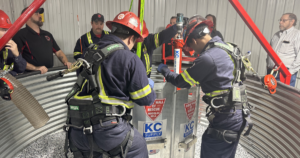
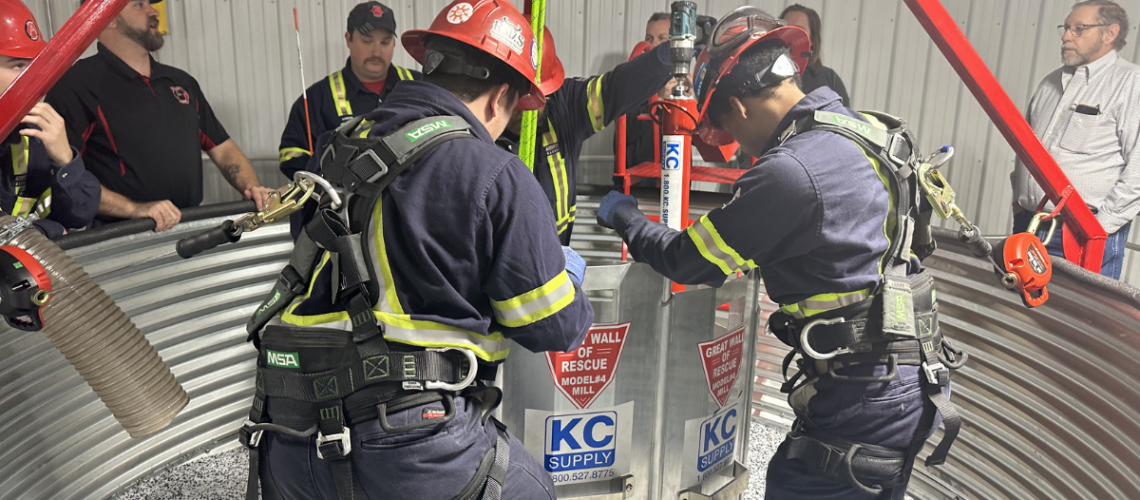
Learn about our Hands-On Training Course: How to Respond to a Grain Bin Emergency
2. Build and Maintain Clear, Practical Policies & Procedures
Knowing the hazards is not enough; your team needs clear, written instructions on how to manage them—and regular training to make those expectations real in day-to-day work.
Key elements of an effective grain bin safety program:
Confined Space Entry Procedures
- Treat grain bins as permit-required confined spaces when conditions warrant.
- Define when an entry permit is required and who is authorized to issue and approve it.
- Specify pre-entry checks: lockout/tagout of equipment, atmospheric testing, communication methods, and rescue planning.
- Require an attendant outside the bin anytime someone is inside, with clear authority to stop the job or initiate rescue.
Lockout/Tagout (LOTO)
- Establish step-by-step LOTO procedures for all equipment that could start unexpectedly or create grain movement.
- Train workers on where all energy isolation points are located—and verify they know how to use them.
- Enforce LOTO during entry, cleaning, maintenance, and troubleshooting; “just for a minute” exceptions are where serious incidents occur.
Grain Bin Entry Protocols
Your written procedures should answer:
- When is entry allowed—and when is it prohibited?
- What PPE is required (e.g., harnesses, lifelines, respirators)?
- How many people are required for an entry?
- What is the process if conditions in the bin change mid-task?
If workers are left to “figure it out” on their own, they will fill in the gaps with habit, assumptions, and shortcuts. Detailed, accessible procedures remove that guesswork.
Incident‑Ready Rescue Planning
- Develop site-specific rescue procedures that account for the layout of bins, access points, and equipment.
- Pre-plan how to access a victim safely, what equipment is needed (e.g., grain rescue tubes, retrieval systems), and how to coordinate with local fire/rescue.
- Conduct drills so that emergency procedures are familiar before a real incident occurs.
Written policies and procedures should be treated as living documents—reviewed after near misses, process changes, or equipment upgrades, and refreshed as regulations or best practices evolve.
Arnco Safety offers expert safety policy consulting to ensure your workplace safety policies are comprehensive enough to protect your employees and meet OSHA requirements.
3. Train for Real-World Conditions, Not Just Compliance
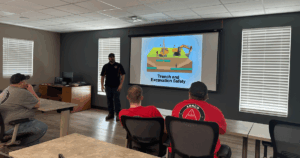
A binder on the shelf or a one-time training session will not change behavior. Effective education is ongoing, practical, and integrated into daily operations.
Consider these approaches:
- Hands-on demonstrations of safe bin entry, lockout, and monitoring practices.
- Scenario-based exercises that walk teams through near misses, dust explosion examples, or entrapment cases and ask, “How would we prevent this here?”
- Cross-training supervisors and leads so safety procedures are enforced consistently, even on nights, weekends, or during peak harvest.
- Refresher training timed around key operations—such as pre-harvest, seasonal cleanouts, or after significant staff turnover.
The goal is not just to deliver information, but to build a shared safety culture in which workers recognize hazards, speak up, and feel supported when they slow down to follow procedures.
Arnco Safety provides more than just certifications—we deliver comprehensive, hands-on training that equips your team with the skills and confidence to stay safe on the job.
4. Use Monitoring Tools to Support – Not Replace – Good Practices
Technology can significantly improve safety around grain bins, particularly when it comes to air quality and combustible dust. But tools are only effective when workers understand what they measure, how to use them, and what actions to take when readings indicate risk.
Dust and Air Quality Monitoring
- Fixed or portable dust monitors can alert teams to elevated airborne dust levels that increase the risk of a flash fire or explosion.
- Continuous monitoring can reveal patterns—such as certain processes, times of day, or weather conditions that cause spikes—so controls can be targeted more effectively.
- Oxygen and toxic gas monitors can identify hazardous atmospheres before entry, and during work, inside bins or enclosed spaces.
Integrating Monitors Into Procedures
Training should clearly define:
- Who is responsible for setting up and checking monitoring equipment.
- What “normal” readings look like for the facility.
- Thresholds at which work must stop, ventilation must be increased, or an area must be evacuated.
- How to document readings as part of permits and post-job reviews.
Without this context, instruments become “background noise”—numbers people glance at but don’t act on. With it, they become critical decision-making tools that reinforce, rather than substitute for, safe work practices.
Bringing It All Together During Grain Bin Safety Week
Grain Bin Safety Week offers a focused opportunity to:
- Review and update bin entry and confined space procedures.
- Conduct refresher training that emphasizes real hazards and real controls.
- Revisit your dust control strategy and monitoring practices.
- Engage workers in discussions about what gets in the way of following procedures—and how to remove those barriers.
Ultimately, preventing grain bin incidents is not about a single device, policy, or training event. It’s about aligning what your team knows, what your procedures require, and what your daily practices reinforce.
When education, clear expectations, and appropriate monitoring tools work together, grain bins can be managed safely—as part of a resilient, informed, and engaged safety culture that protects every person who steps on site.